What if There Was a Massive EV Charging Station in Upstate NY Run on a Diesel Generator?
As a Tesla owner, I've had my fair share of debates about electric vehicles (EVs) and their efficiency compared to traditional gasoline cars. Recently, I had a conversation with my buddy Rob, a licensed plumber who knows his way around gas, propane, and diesel systems. While Rob understands the basics, he often gets lost when it comes to grasping just how efficient EVs are compared to even the most cutting-edge combustion vehicles.
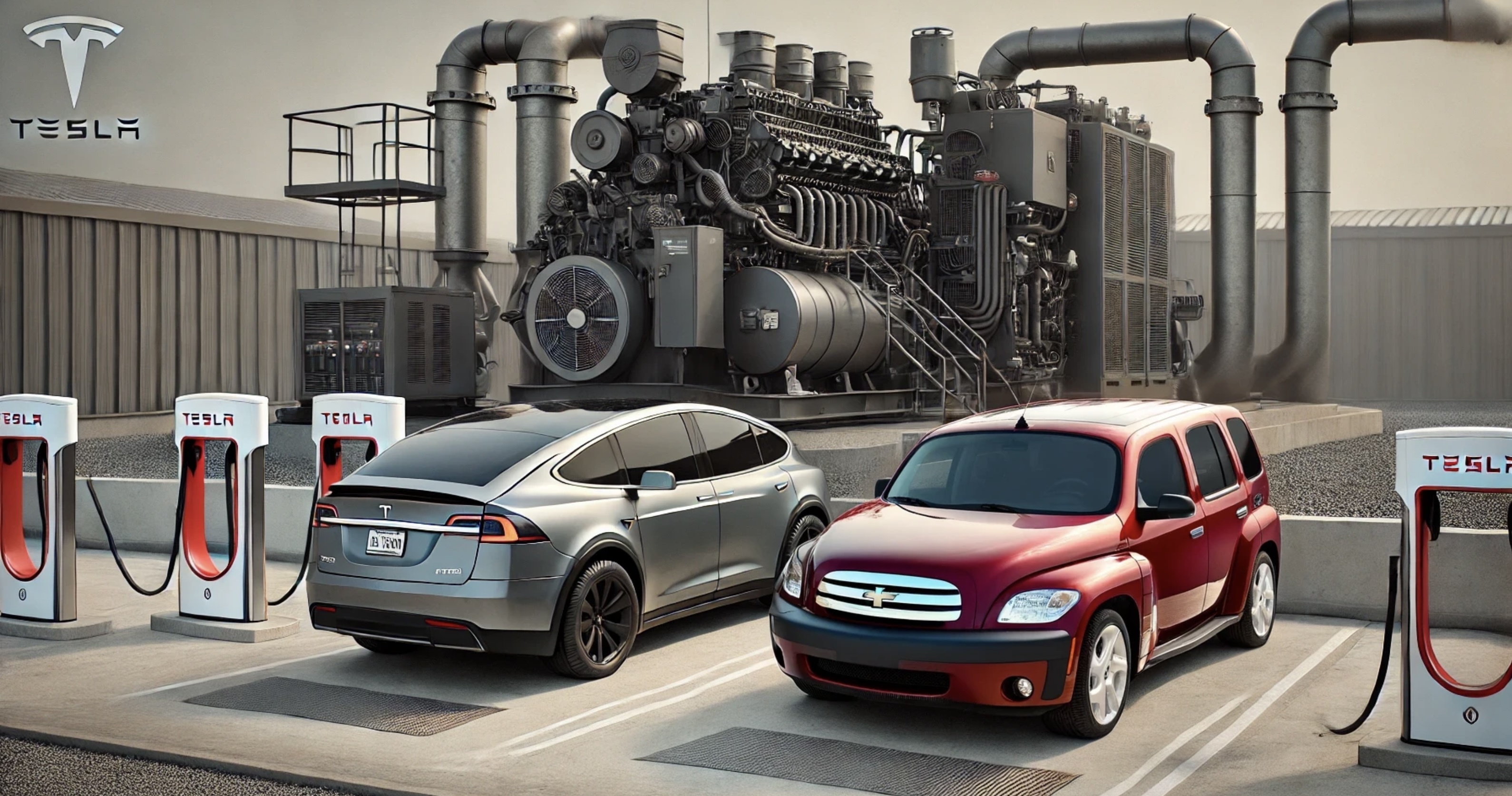
In our latest chat, Rob brought up a common critique: "If you're charging your Tesla with electricity from a diesel generator, aren't you just shifting the emissions and inefficiencies elsewhere?" This got me thinking. What if there was a massive EV charging station in upstate New York powered by a diesel generator? How would that compare, efficiency-wise, to driving a standard gasoline car like the 2008 Chevrolet HHR?
I decided to crunch the numbers to give Rob—and anyone else curious—a mathematically accurate comparison.
The Hypothetical Charging Station
Let's imagine a large EV charging station equipped with a downsized version of the GE 9HA.02 gas turbine generator. Instead of its full 826-megawatt (MW) capacity, we'll consider a smaller model producing 50 MW of power. This setup would:
- Charge 36 vehicles simultaneously at high speeds.
- Charge backup batteries to manage peak demands and store excess energy.
- Supply surplus power to the grid, creating an additional revenue stream.
Generator Efficiency
The GE 9HA.02 operates at a net efficiency of 64% under specified conditions, converting diesel fuel into electricity. At 50 MW, the generator efficiently powers the EV charging infrastructure and supports the grid.
Comparing the 2008 Chevy HHR and 2022 Tesla Model X
| Vehicle | Fuel Efficiency | Energy Consumption (kWh/mile) | Engine/Overall Efficiency |
|---|---|---|---|
| 2008 Chevrolet HHR | 23 mpg | 1.465 kWh/mile (from gasoline) | 22% efficiency |
| 2022 Tesla Model X (Charged with Diesel Generator) | Electric (charged by diesel generator) | 0.637 kWh/mile (from diesel fuel) | 51.8% overall efficiency |
Energy Consumption Comparison
Chevy HHR Total Energy Consumption: 1.465 kWh/mile (from gasoline).
Tesla Model X Total Energy Consumption: 0.637 kWh/mile (from diesel fuel).
The Tesla Model X uses approximately 56.5% less energy per mile than the Chevy HHR.
Utilizing the Generator's Potential
The 50 MW generator can charge 36 Teslas at up to 250 kW each (totaling 9 MW), while charging backup batteries and selling up to 41 MW of excess power to the grid for additional revenue.
Breaking Down the Efficiency for Rob
I explained to Rob that even when an EV is charged using electricity from a diesel generator, it's still more efficient than driving a gasoline car like his Chevy HHR. Here's why:
- The GE generator converts diesel fuel to electricity at 64% efficiency, while the HHR's engine is only 22% efficient.
- The Tesla's electric motor and battery system use electricity at 81% efficiency, resulting in an overall efficiency of 51.8% from diesel fuel to the wheels.
- The Tesla consumes 0.637 kWh/mile, while the HHR consumes 1.465 kWh/mile, making the Tesla about 56.5% more efficient.
Conclusion
Even when powered by a diesel generator, electric vehicles like the Tesla Model X are inherently more efficient than traditional gasoline cars like the Chevy HHR. This efficiency stems from the advanced design of both the generator and the electric drivetrain. The next time someone questions the efficiency of your Tesla, you can confidently say that EVs, even in imperfect charging scenarios, still offer superior energy efficiency and reduced emissions compared to internal combustion vehicles.